


Play More Games









Play Chess Online Game for Free
Two players play chess. Western chess or international chess distinguishes it from xiangqi and shogi. The modern version of the game evolved in Spain and Southern Europe in the 15th century after evolving from chaturanga, an ancient Indian game. Millions of people play chess worldwide.
Chess is a non-hidden abstract strategy game. It's played on a 64-square, 8x8 chessboard. Each player starts with a king, queen, two rooks, two bishops, two knights, and eight pawns. The first player moves white pieces, the second black. The goal of chess is to checkmate the opponent's king, meaning it can't escape. Several ways can end in a tie.
Since the game's birth, chess theory has grown. Chess composition contains artistic elements, and chess has affected Western culture, art, math, computer science, and psychology.
Early computer scientists wanted to build a chess machine. Today's chess engines are stronger than the greatest humans and have influenced chess theory.
How to Play the Chess Online Game for Free
Chess pieces are color-coded. The light set may be yellowish or off-white, while the dark set may be brown or red, but they are usually called "white" and "black." White and Black are the sets' players. Each set includes a king, queen, two rooks, two bishops, two knights, and eight pawns. Staunton sets are preferred for competition.
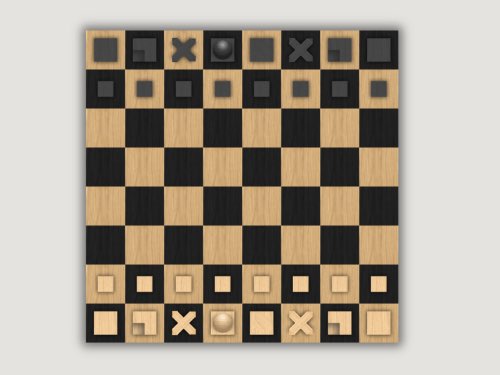
The board has eight rows and eight columns (called files). By convention, the 64 squares alternate in light and dark hues; popular chessboard colours are white and brown or white and dark green.
White's initial rank is rook, knight, bishop, queen, king, bishop, knight, rook. Eight pawns line the second rank. Black's piece on the same file mirrors White's. Each player's right-hand corner has a light square. The exact king and queen locations can be remembered by the term "queen on her own colour." The white queen begins on a light square and the black queen on a dark square.
In competitive games, organisers assign piece colours; in casual games, colours are frequently selected randomly, for example by a coin toss or by one player concealing a white and a black pawn and letting the opponent choose.
After white moves, players exchange turns, advancing one piece every turn, except when casting. A piece moves to an unoccupied square or an opponent's occupied square and captures it. All pieces capture by moving to the opponent's square, except en passant. Even if moving is negative, a player can't skip a turn.
Every piece moves differently. A piece can move if no other pieces of any colour are in the way (except the knight, which leaps over any intervening pieces). All pieces save the pawn can capture an enemy piece if it's on an unoccupied square.
Initials identify components. These are K, Q, R, B, and N in English (knight; N is used to avoid confusion with king). Figurine algebraic notation (FAN) is employed in chess literature to improve comprehension.
Over 2,000 chess variants have been published. Most are new.